
From Quote to Delivery: Checking Quality Systems During a Factory Visit
A factory visit can make a quality system more concrete by following an actual product from requirements and incoming materials through production, inspection, nonconformance handling, and release. Review records and observe work against the order’s scope rather than collecting certificates alone. A management-system certificate describes an organization within a stated scope; it does not prove that every product or shipment meets a buyer’s requirements.
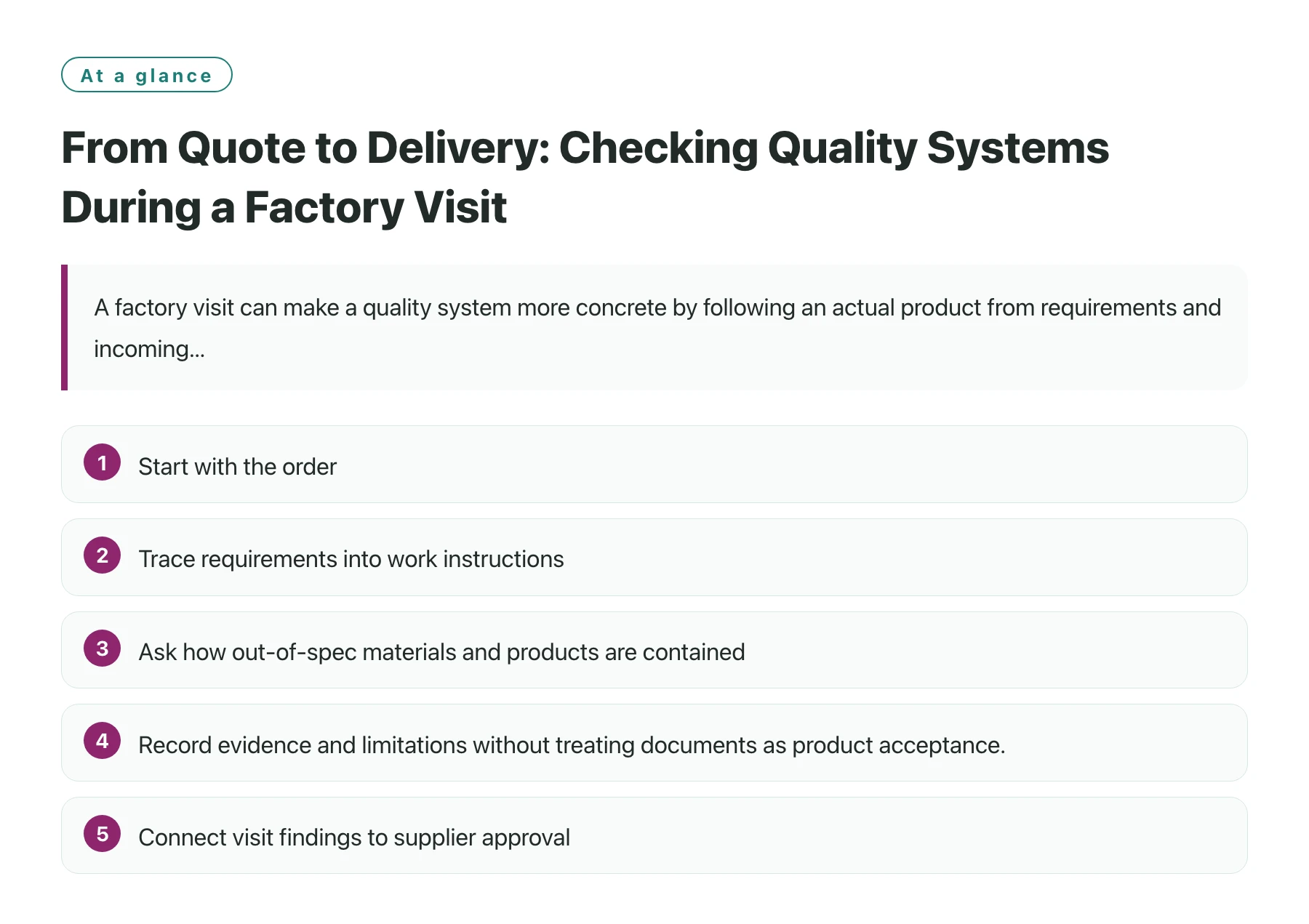
Key takeawaysStart with the order, product revision, site, and risks the visit must address. · Trace requirements into work instructions, process checks, results, and release records. · Ask how out-of-spec materials and products are contained, corrected, and verified. · Record evidence and limitations without treating documents as product acceptance. · Connect visit findings to supplier approval, order gates, and later performance reviews.
A useful review checks whether the factory’s stated process can be seen in current records and practice.
1. Begin with the quotation and order risks
Bring the approved quotation, purchase order, specification, drawings, sample approval, delivery dates, and known open issues. Identify the product, quantity, factory, and operations in scope. Ask the buyer which failures would most affect safety, function, compliance, cost, or delivery. Use those risks to choose a few records and process steps to trace rather than attempting a shallow review of every department.
Confirm whether the visit is a capability review, a management-system audit, an order-specific process check, or a product inspection. These activities overlap in the questions they raise but produce different conclusions. State what the visit can establish and which tests, legal determinations, or future performance claims remain outside scope.
2. Check the site and certificate scope
Match the legal entity, manufacturing address, certificate holder, scope statement, issuing certification body, and validity information. Confirm that the certificate covers the facility and relevant activities in the order. Ask whether a new site, outsourced process, or production line falls within the organization’s controls. If a document has a different name or address, establish the relationship with traceable evidence rather than assuming it applies.
ISO 9001:2026 is the current published edition of the quality management systems requirements standard. If a supplier presents an older certificate or transition plan, ask the certification body or qualified owner to confirm its status and applicable arrangements. A certificate indicates a system scope; it should not be presented as product certification or proof that the current purchase order conforms. [1]
3. Trace a customer requirement into production
Select a requirement such as material, critical dimension, finish, fit, function, or packaging. Follow it from the purchase order and technical review into production planning, work instructions, inspection points, and acceptance records. Ask who confirms that revisions reach operators and how obsolete documents are removed from the point of use.
Compare the record with actual work on the floor. Check model, revision, lot, date, operation, result, and responsible person. If staff use a local checklist or translated instruction, compare it with the controlled source. Record differences and ask how they are approved. A document can be complete while the production team uses a different version, so the visit should test both record and practice.
4. Review incoming materials and supplier controls
Ask how incoming materials are identified, checked, accepted, stored, and linked to finished product. Trace a sample lot to its purchase record, supplier, inspection result, and production batch. Review how the factory approves new sources and handles material changes. For critical components, check whether the buyer’s requirements and evidence are flowed to the sub-supplier.
Look for visible segregation of accepted, quarantined, returned, and unidentified materials. Ask who may release a hold and what evidence they need. If a material certificate is used, match its model, lot, supplier, and test scope. A generic supplier certificate should not replace specific evidence required by the purchase specification.
5. Observe process monitoring and equipment controls
Identify process parameters that affect the product and ask how they are measured or monitored. Review instructions, measurement equipment, calibration status, maintenance records, operator training, and reaction plans. Select an actual recent production record and compare it with the stated process. Note whether control limits and escalation rules are clear to the people who perform the work.
A factory visit should not require a buyer to decide engineering adequacy without competence. If a parameter, fixture, or test requires a specialist, record the question and assign it to an engineer or qualified reviewer. The objective is to establish what the factory controls and what evidence exists, then determine whether that evidence matches the order and risk.
6. Follow a nonconforming product through closure
Ask the factory to show a recent nonconformity and trace its identification, containment, disposition, corrective action, and effectiveness check. Confirm how affected lot quantities are identified and whether similar products or other orders are assessed. Review how rework or concession receives authorization and how repaired goods are reinspected before release.
Separate correction from corrective action. A repaired item addresses the immediate defect; an investigation may address a cause and prevent recurrence. Record whether evidence supports the stated cause and whether follow-up verified the change. Do not assume that a closed form proves the issue cannot recur. For a serious or repeated problem, the buyer may need additional controls or a later verification visit.
7. Check final inspection, document control, and release
Review how finished goods are sampled or tested, who makes the acceptance decision, and how results connect to the lot and purchase order. Check labels, packing records, certificates, instructions, and shipment documents when they are part of the order. Ask what happens when an inspection fails or required evidence is missing. Identify who can hold or release goods and where that authorization is recorded.
Compare the sample report, approved specification, and actual product records. If the buyer has a separate third-party inspection, determine how its findings enter the factory’s corrective-action process. A final inspection does not replace process control, and a system certificate does not replace product acceptance. Keep each piece of evidence within its proper scope.
8. Report findings and follow through to delivery
Write findings with the requirement or question, observed evidence, location or lot, risk, limitation, owner, due date, and verification method. Distinguish nonconformity from a question or improvement opportunity. Agree which actions must close before supplier approval, production start, or shipment. Preserve photos and record references with the report, subject to site confidentiality rules.
After delivery, compare system findings with actual defects, changes, delays, and corrective-action performance. Update supplier risk based on evidence from the relevant product and site. Buyers working with JS Sourcing can carry observations from a factory visit into sourcing and order planning, while leaving formal acceptance and compliance decisions with authorized owners.
Sources
Frequently asked questions
Does an ISO 9001 certificate prove a product meets the purchase order?
No. It covers a quality management system within its scope. Product conformity requires order-specific requirements, test or inspection evidence, and an authorized acceptance decision.
What should a buyer trace during a factory visit?
Choose a key requirement and follow it through controlled documents, materials, production instructions, process checks, nonconformance handling, final inspection, and release records.
Should an older quality certificate be accepted automatically?
No. Check certificate scope, issuing body, site, status, edition, and any transition arrangements with the certification body or qualified owner.
What should happen to open factory-visit findings?
Assign each finding an owner, evidence request, due date, risk, and closure gate. Verify corrective action before the decision it affects, such as supplier approval or shipment release.
Start your discreet consult
Board-licensed physicians. NABP-accredited pharmacies. Plain-box shipping. From $1.20 a dose.
Start Online Consult — From $1.20/dose